Posts

Showing posts with the label #weeklyedpost

Where's the research? Why we need to stop looking in the rear vision mirror at longitudinal research and data.

Image
Don't get me wrong. There is no question that educational research is useful and that understanding what has worked in the past can and should inform our decisions about which pedagogical interventions we use day to day. However if we limit ourselves to what is formally researched and published in peer reviewed papers we are going to continue to fail a good portion of our young people. To get a change in outcomes we must change our practice. “If you always do what you’ve always done, you’ll always get what you’ve always got.” - Henry Ford It concerns me that there is still a tendency (for some) in education to dismiss new approaches, new strategies, new ideas, patronisingly belittling new ways of doing things as fads and passing fancies, simply because there is yet to be a lofty body of evidence that proves it works across the board. Sitting around and waiting for the evidence to be served up on a silver platter before you are willing to try new interventions and strategies ...

Navigating the space between educational paradigms

Image
Source One of the toughest things about being a champion for educational change is that you need to take people with you. In fact sometimes its even tough to take yourself with you. Many times on this blog (and basically any chance I get to speak to groups) I have spoken about the need for educational change (see a particularly ranty presentation here ). I know I am not a lone voice, in fact I get the sense that there is a veritable tsunami building up behind what initially felt like ripples and then waves of educators talking about this very issue. People like Sir Ken Robinson popularised the notion that schools need to change with his TED talk How Schools are Killing Creativity and Changing Educational Paradigms . This was echoed and reinforced by the work of Sugata Mitra with his hole in the wall work and his TED talk Build a School in the Cloud  and I know we all cheered for that Logan LaPlante for whom Hackschooling made happy . Locally we have a growing number of educa...

So why are you still doing NCEA Level One?

Image
At HPSS we have been pondering this question for a while. There are a number of reasons we have been tackling this question.  Firstly, because Maurie keeps asking us. ( See his post on our NCEA journey here. )  Secondly, because there is an increasing sense that students are being over assessed and are being forced to focus on formalised high stakes assessment for three (or possibly even four) years running.  Thirdly, there is the issue that Level One NCEA Certificate is of little value. Once upon a time School Certificate did serve as an exit certificate for some, but today little if any students are likely to end their schooling journey at Level One.  There's also the fact that you don't even need to do Level One to get Level One! As long as students get Level Two they actually achieve Level One by default at the same time - magic! To add to this there is also the very real issue of student stress and anxiety bought on by over assessment...

Effective Andragogy - Universal Design for Leading and Visible Leadership

Image
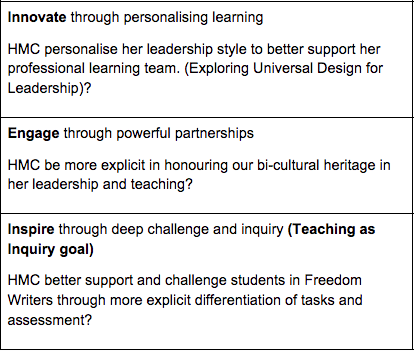
This year I am undertaking a number of personal professional and teaching inquiries. I am participating in the National Aspiring Principals Programme (NAPP) where I am undertaking a leadership inquiry. I am also working on Masters in Educational Leadership for which I am intending to complete a thesis (in the next year or two). As well as these two external opportunities for inquiry I am also completing three inquiries that are borne out of my personal professional learning plan I am completing as part of our professional learning and appraisal cycle at HPSS. Our HPSS Personal Professional Learning Plan is an attempt to support staff in developing a sense of agency and ownership of their professional development, but done in such a way that ensures their inquiries are focused around putting the HPSS Principles of Innovate, Engage and Inspire into practice. Within the goals there may be 1-3 teaching inquiries with the opportunity to also focus on 1-2 more personal inquiries around th...

How might we deliver a NCEA qualification pathway that reflects our vision and values?

Image
NB. All of this in draft. The following reflects our thinking at this stage only. Too often in schools assessment is the the tail that wags the curriculum design dog. At HPSS is is our aim to challenge and instead design an approach to NCEA that is determined by our vision for teaching and learning...and not the other way around. So what is our vision, principles and values at HPSS? Our Vision What we want for our young people: To create a stimulating, inclusive learning environment which empowers learners to contribute confidently and responsibly in our changing world. Our Principles The foundations of our curriculum decision-making are: Innovate through personalised learning Engage through powerful partnerships Inspire through deep challenge and inquiry to develop  empowered learners Our Values Excellence Inquiry Connectedness Collaboration Innovation So how might this translate into a vision for NCEA that is stimulating and inclusive, that innovate...

So what are you doing differently this year in your classroom (and/or school)?

Image
Source Whether you did a formal inquiry into your teaching practice last year or simply taught some kids and did some some stuff, one truth will remain - there are a number of things you need to change about your teaching and/or learning environment this year. As my ancient buddy Heraclitus once stated (admittedly didn't hear him first hand, but am choosing to trust my sources), "the only constant is change". Now this is most certainly true of our world, society and most work places, but unfortunately bar a change of names on your class roll this often not the case in the classroom. I acknowledge change is challenging and many of you work in environments where change feels glacial at best, however that needn't bother any of us as change starts with you! Whether you are in a dynamic environment where everyone is striving for "adaptive expertise" or feel like you are a lone nut in a school where the status quo (which may well produce excellent academic r...

Graduating Teacher Standards - Are they future-focused enough?

Image
As you may (or may not) know, one of the many and varied roles of the New Zealand Teachers Council is to approve and review all Initial Teacher Education programmes. It was during my first council meeting where a number of the new Masters ITE programmes were being approved that the question came to me (once again): Are the Graduating Teacher Standards future focused enough?? The reason I asked myself and others this, is that I felt the courses we were looking at could have offered more. It wasn't that they weren't rigorous and well thought out, it was just that they felt lacking, particularly in the 'future-focused skills' area. When I voiced these concerns the response I got was, that we couldn't demand the courses to include anything that wasn't demanded in the graduating teacher standards. On reading the standards more closely I am not so sure. Surely if you take the second point of Standard One "have pedagogical content knowledge appropriate to the l...

Mindfulness and the Machine

Image
Simply Being App This is something I have been thinking about for a while, borne mostly out of my own bad habits of being "connected" and "online" for most of my waking hours. I suspect I am not alone. I love technology and I love it's capacity to provide instant information (and gratification) at the click of the button. In many ways technology allows me to be hyper-efficient - emails responded to quick smart, meeting minutes created and shared on the spot, sharing or rather over sharing every magic moment, meal and milestone instantly. In my teaching I was an exuberant early adopter of technology, embracing the way that it allowed me to make learning available 24/7, supported young people to share and publish rather than simply "hand in" work. When I am not teaching I am learning via this hyper connectivity, reading articles, blogposts, watching TED talks and connecting with educators around the globe via Twitter and Google+. When not learning, ...