Posts

Showing posts with the label Universal Design for Learning

NCEA - Considering the 'Big Opportunities'

Image
These recent months have seen a number of groups start putting their stake in the ground around the NCEA Review. It has been interesting seeing people reveal their cards, and often exposing some odd assumptions about what is actually being reviewed and who is shaping the review within the Labour/Green/NZ First camp. For the sake of "joining the conversation" I thought I might share some my personal thoughts about the NCEA Review and it's proposed "Big Opportunities". Note - the parts in italics are taken from this document:  Download the Big Opportunities discussion document  which can be found here .  For what it's worth I actually think NCEA is pretty cool as it is. I like it's flexibility and that it already let's "you do you". If anything I think it is our mindsets that needs to be reviewed first before we get to the actual framework. Here is my pondering about that perspective:  NCEA - we need to review our mindset first But t...

"Tech doesn't improve student results - study" - why news reports like this are damaging (and missing the point).

Image
Source: TV3 News Journalists love a bit of scaremongering and in many ways I can't help feeling that the reporting of a recent OECD report on the impact of technology on results is just that. As I read news report after news report last night (many of which seemed to be either directly taken from Reuters or an OECD press release with little or no critical analysis) I could nearly hear the shrieks of delight from the pearl clutching naysayers bubbling with excitement at the "evidence" that, clearly, change is bad. Now don't get me wrong, I have no issue with the report itself, or the fact that the OECD are looking at the impact that tech has on results such as PISA. Look at the actual OECD site and it is interesting reading (you can also see the full report here), their discussion actually focuses on the need for a "new approach needed to deliver on technology’s potential in schools" - and they are absolutely right. Technology integration needs to b...

Teaching as Inquiry - How might Claire better differentiate tasks to meet the needs of diverse learners?

Image
Source Over the course of Semester One, all teaching staff at Hobsonville Point Secondary School have undertaken a personal Teaching as Inquiry project, which enables teachers to focus on the specific needs of their learners but also provides a focus for the teacher's personalised professional learning plan. I taught one Small Learning Module this semester, which was co-taught with Sarah Wakeford (our Learning Partnership Leader and Social Scientist extraordinaire). Our module was called Freedom Writers to Freedom Fighters - an English and Social Science integrated module looking at human rights and the literature that surrounds it, with a particular focus on black civil rights in Term One and the Treaty of Waitangi in Term Two. Our class was made up of 60 Year 10 students who range from curriculum level three to beyond curriculum level six plus. To add to the complexity there was the fact that I was often away with the NZTC so needed to ensure that any resources I created ...

Effective Andragogy - Universal Design for Leading and Visible Leadership

Image
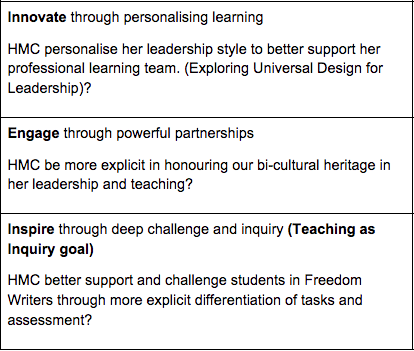
This year I am undertaking a number of personal professional and teaching inquiries. I am participating in the National Aspiring Principals Programme (NAPP) where I am undertaking a leadership inquiry. I am also working on Masters in Educational Leadership for which I am intending to complete a thesis (in the next year or two). As well as these two external opportunities for inquiry I am also completing three inquiries that are borne out of my personal professional learning plan I am completing as part of our professional learning and appraisal cycle at HPSS. Our HPSS Personal Professional Learning Plan is an attempt to support staff in developing a sense of agency and ownership of their professional development, but done in such a way that ensures their inquiries are focused around putting the HPSS Principles of Innovate, Engage and Inspire into practice. Within the goals there may be 1-3 teaching inquiries with the opportunity to also focus on 1-2 more personal inquiries around th...

Hack Your Classroom: Week 6 - Meeting the Needs of Diverse Learners

Image
This is a topic that has long been close to my heart. It really began with a two day conference with Carol Ann-Tomlinson, the woman I consider to be the guru of differentiation. It was her analogy of likening teaching through one mode or strategy as being akin to playing Ten Pin Bowling with just one ball - some days you were lucky a pulled off a strike, but more often you than not,  you only knocked down one or two or more likely achieved a gutter ball. It was this analogy that caused a light bulb moment where I realised by having a singular approach I was quite possibly robbing many of my students of the opportunity of being engaged and learning the best they could. Tomlinson's approach to differentiation has three layers. She argues that we should be differentiating for student readiness (not the same as ability), student interest and/or student learning style. Learning can then be differentiated by Content (or context), process, product or learning environment.